
This story was originally published in the Florida magazine Folio Weekly for the week of December 10, 2014.
No one knows exactly what happened that spring night in May 1940, as the S.S. Bodegraven floated farther and farther away from the Dutch port of IJmuiden.
Jacques Goudstikker climbed up to the deck to have a smoke, while his wife and infant son stayed below. Across the water, the renowned art dealer’s once-glamorous life was vanishing into the darkness, a life of castles and parties, of Van Goghs and the Old Masters.
But the Nazis had come, and The Netherlands was no longer safe for a Jew.
Some time in that dark night, Goudstikker slipped into an open deck hatch. He died at age 42, his neck fractured. And back in The Netherlands, his art collection — 1,400 pieces strong — would likewise be fractured, divvied up among Nazis and their supporters and later scattered around the globe.
• • •
Seventy-two years later, Holly Keris, chief curator of the Cummer Museum of Art & Gardens in Florida, received a letter about one of those paintings, Vanitas by Dutch Golden Age artist Jacques de Claeuw (1623-1694), which was now in her charge. The letter was from Goudstikker’s heirs. They wanted their painting back.
Vanitas is one of the museum’s oldest acquisitions, purchased only a year after the Cummer opened in 1961; it has been on near-constant display ever since.
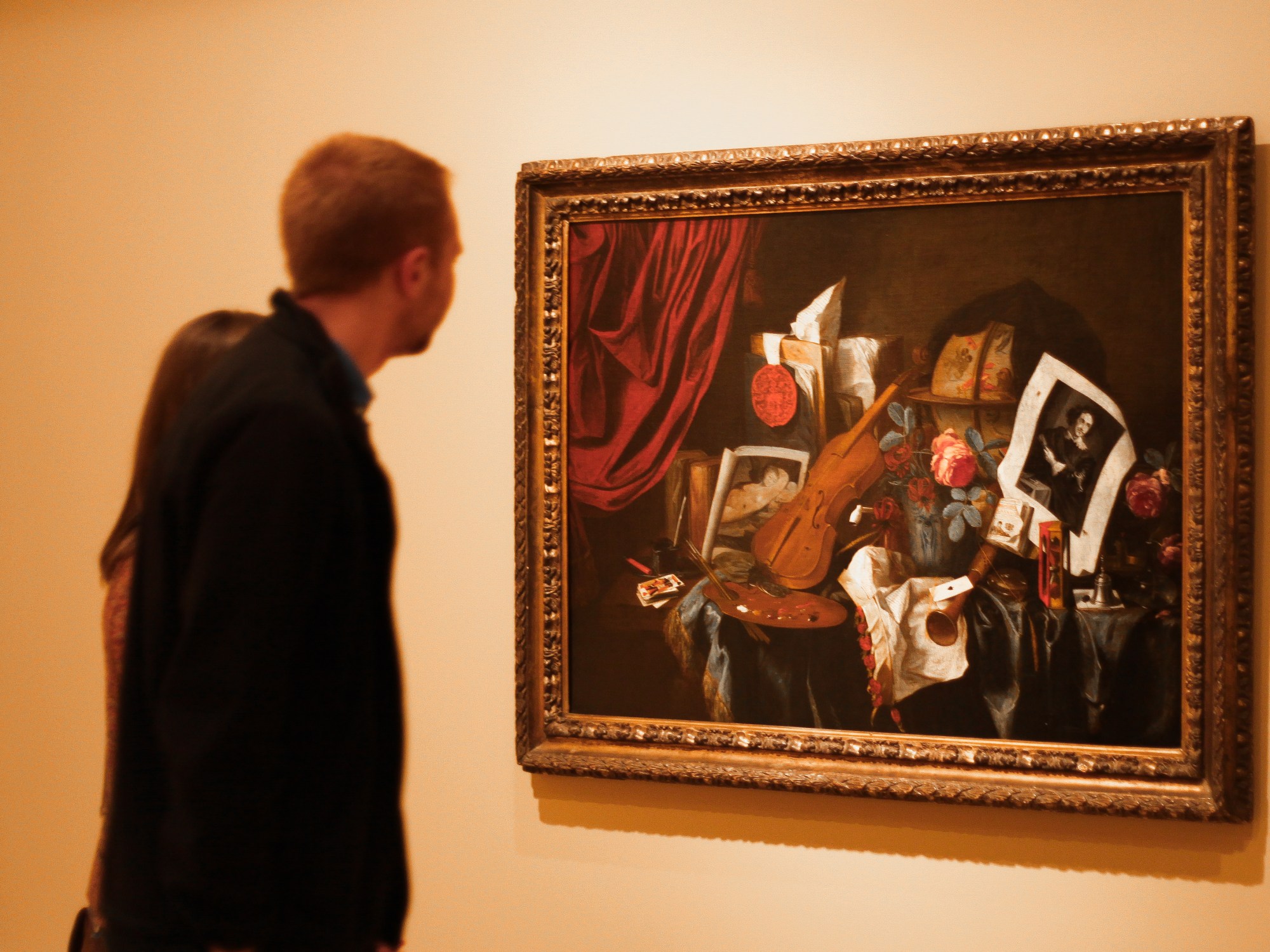
The 337-year-old painting looks like little more than a pile of junk immortalized in oil on canvas. It depicts a mess of crumpled paper, forgotten playing cards and creased portraits. Flowers with stooped necks overlook the disarray. To one side of the canvas, a painter’s palette slowly dries. On the other, an hourglass empties, grain by grain.
In many respects, Vanitas is a seemingly humdrum still-life. It’s not even one of a kind. De Claeuw spent much of his career producing paintings he called Vanitas — taken from the Latin word for “vanity,” a mortal sin — all depicting similar scenes of excess and decay. To him, these weren’t just paintings. They were moral statements, tributes to the fleeting nature of worldly possessions and the impermanence of life itself.
So it’s ironic, perhaps, that this painting now symbolizes a triumph over the amnesia of time.
In June, the Cummer announced an agreement with Goudstikker’s heirs that enabled the museum to keep Vanitas in its gallery, with the family’s blessing. That much made the local television news and the pages of the Florida Times-Union.
But the story of Vanitas, of its theft and recovery, goes much deeper.
Vanitas marks one victory in an ongoing struggle for the Goudstikker heirs, and for Holocaust victims in general. Between 1933 and 1945, the Third Reich stole upward of 20 percent of all European art in what’s believed to be the largest art theft in history. Unlike Vanitas, much of it has never been recovered, and may never be.
• • •
Jacques Goudstikker was no small-time collector. He was one of Europe’s most famous art dealers, a man whose reputation and taste were highly regarded the world over, even by the Nazis.
The pre-war period was an opulent one for Goudstikker. He set up a gallery overlooking the canal on Amsterdam’s chic Heerengracht Street, and he renovated a second space — the stately Nijenrode Castle, complete with moat and drawbridge — to exhibit more of his paintings.
In these galleries, Goudstikker displayed masterpieces spanning the centuries. Innovative paintings from the likes of Van Gogh hung on the same walls as oeuvres from Bruegel and Rubens.
It was at Nijenrode Castle in 1937 that Goudstikker met his second wife. He had hired the Viennese State Opera to perform a benefit concert for Germany’s persecuted Jews, and star soprano Dési von Halban-Kurz was scheduled to appear.
The singer and the art dealer caught each other’s eye. They were married shortly thereafter in 1938.
Decades later, Charlène von Saher and her sister would ride past Nijenrode Castle, the Heerengracht gallery and the Goudstikkers’ private home in Ouderkerk. It was a yearly ritual they shared with their grandmother Dési.
For two weeks every summer, the children would visit Holland, and each year, they would stare out of a car window, catching glimpses of the past.
“Whenever we were there, we would drive around with her,” Von Saher told Folio Weekly in a recent telephone interview. “I always thought, ‘Why? Why is she not living in these gorgeous castles and villas? What happened?’ But when you’re a child, you don’t understand all the things that happened.”
There was little talk of the Nazis. Dési had moved on with her life, but the subject remained emotional for her. She had just a few years together with her husband before he died aboard the S.S. Bodegraven.
Shortly after the family fled — and Goudstikker fell to his death — Hermann Göring, a top-ranking member of the Nazi Party, forced the Goudstikker gallery to “sell” its pieces for laughably low prices. Göring took 300 for his hunting castle. About 50 were given to Adolf Hitler. And Vanitas itself was snapped up by one of Göring’s henchmen, the German banker Alois Miedl.
Try as she might, Dési was never able to recover her husband’s art collection, even after the war, even after Göring and Hitler were dead. But Dési chose not to emphasize the pain of these events to her granddaughters.
“We weren’t talking about the art and how everything was stolen,” Von Saher says. “We weren’t talking about that kind of stuff. She was just telling us about how Jacques would have loved us and how great he was.”
Only when Von Saher, now 39, reached her teenage years did she start to understand what had happened to her grandfather and his life’s work. But it would ultimately be a journalist who would reacquaint her with the full extent of the Goudstikker collection.
It was 1997, and the Von Saher family was reeling from the recent deaths of both Dési and her son Eduard, Von Saher’s father. “We were trying to get our lives back together,” Von Saher says, when the phone rang for her mother Marei.
The caller was Dutch journalist Pieter den Hollander.
“He basically said, ‘Do you know you might have a claim to your father-in-law’s art collection?’ And my mom was a little shocked. We all were.”
This was the moment that would launch a legal odyssey, and the family’s mission to find Goudstikker’s stolen art.
• • •
Hollander flew to Connecticut, where the Von Sahers had settled, to meet the family.
“He asked if we had anything in the house that had once belonged to Jacques,” Von Saher recalls. “And we did. We had this one little painting.”
Dési had returned to Amsterdam in 1946, in an attempt to recover her late husband’s once-vast collection. She passed by the old Goudstikker gallery, where an employee recognized her and handed her a bundle. It contained a small canvas, wrapped in a blanket.
“It was the one piece that was kept and survived the war,” Von Saher says.
The painting depicted two figures — a study of the same girl at different angles — but Von Saher and her sister had always seen themselves in its brushstrokes.
“It was something my grandfather had without knowing he was going to have two granddaughters,” Von Saher says. “It was always really sentimental to my grandmother, and then to our parents, and now to my sister and me.”
But that day, Von Saher saw something new as Hollander flipped the canvas over.
“He turned it around, and he said, ‘Look, this is your grandfather’s wax seal and his stickers,” Von Saher says. Hollander explained that all Goudstikker paintings bore those seals, even to this day.
“At the time, I didn’t understand that,” Von Saher says. “I thought, ‘Well, if all those other paintings were stolen, and they all have the same verification on the back, why didn’t the Nazis take all that off?'”
The Nazis were meticulous record-keepers, Von Saher would learn. They kept the seals as a mark of quality.
Goudstikker, as it turns out, was equally meticulous; the clues to the modern-day recovery efforts lay in the little black book he kept as he fled Holland. With 165 pages and a list of the more than 1,200 works in his collection, Goudstikker’s book “became our key to restitution,” Von Saher says.
The notebook’s descriptions could take the family only so far, though. They needed to know what the paintings actually looked like to find the missing pieces. So a team of researchers, hired by the Von Saher family, set out to match the descriptions to the photographs of existing artwork.
It remains an arduous process, one that has taken many years and many experts.
Nancy Parke-Taylor works for the Toronto-based Mondex Corporation, which specializes in restitution claims like those of the Von Saher family. The legal bills for these sorts of claims, she says, can often total in the six figures, if not higher — and sometimes, the recovered artwork must be sold to cover the costs. Moderately valued paintings might never be reclaimed as a result.
“Some people think that all Nazi-looted art is multimillion-dollar paintings and that sort of thing,” Parke-Taylor says. “That’s simply not the case. I’m sure there are a lot of people out there who basically cannot do anything because it’s not only time-consuming but too costly.”
Then there’s the challenge of navigating different laws in different jurisdictions. While 44 countries have signed the Washington Principles, a set of guidelines for the return of Nazi-stolen art, the guidelines are not binding, and many states have developed wildly different rules.
Take New York and Switzerland. In the state of New York, it’s fairly straightforward: Stolen art belongs to the original owner and should be returned. But in Switzerland, the law makes an exception for “good faith” buyers who bought a piece without knowing its tarnished past. This has led to one Jewish heir protesting openly on Swiss streets, outside the museum where his family’s painting is being kept.
And the law can get even more complicated, depending on who has the art and who wants it back.
In some cases, museums are legally obligated to keep a piece of looted art in their collection, as part of their duty to protect the public interest. In others, there are multiple heirs, each with different wishes for the fate of the artwork.
In the case of the Von Sahers, there is only one legal heir — Marei Von Saher, daughter-in-law to Jacques and mother to Charlène — which simplifies matters. Still, locating the missing Goudstikker paintings and getting them back has not been easy.
Works from the Goudstikker collection hav turned up in Israel, Austria, Germany and even Los Angeles’s Getty Museum. Some were more easily reclaimed than others. One museum in Dresden returned a painting in a matter of days. Other claims have gone to court.
In 2006, after years of legal proceedings, the Dutch government was forced to give back 200 paintings to the Von Sahers. And the family continues to fight for another pair of paintings — worth an estimated $28.3 million — currently owned by a California museum.
Despite all the years and all the effort, only about 250 Goudstikker paintings have been reclaimed. “Ms. Von Saher is still seeking to recover hundreds of paintings. And that’s one claimant,” says Frank Lord, one of Von Saher’s lawyers.
• • •
Many museums, including the Cummer, are creating avenues for Holocaust survivors to reconnect with their stolen valuables.
In 2003, the Cummer made a list of its pieces with unclear origins and submitted it to the Nazi-Era Provenance Internet Portal, an online database that helps bring survivors and their heirs together with their lost artwork.
Keris, the curator, says she was not surprised to learn there were Nazi-looted works in the Cummer’s collection. In fact, Vanitas was not even the first case.
In 2010, the heirs of a prominent German banker, Gustav von Klemperer, identified a delicate teapot and coffee pot from a Cummer porcelain catalogue from the 1980s. Keris and the museum board returned the pots to von Klemperer’s heirs.
“As much as you don’t like to say it, I don’t find it surprising in the least that there are pieces that have been at the Cummer, at the Met, at the Getty, at the MFA Boston, that are sitting there and are waiting for people to find them,” Keris says. “It’s not shocking in the least. In fact, I think it is gratifying when pieces can be returned to the people who lost them.”
So when 2012 rolled around and a new claim came in, Keris knew what to do.
First came the letter from the Von Saher family’s lawyer, identifying Vanitas as one of Goudstikker’s pieces.
In its pages, the letter revealed a history far more complex than anyone at the Cummer ever realized. “We knew [Vanitas] had been part of an auction in the 1940s, but that it didn’t sell,” Keris says. “That was really the extent of the known history of the painting.”
No one knew it had passed through the hands of the infamous Göring.
The Cummer had to verify the claims and gather its Board of Trustees for meetings — both time-consuming processes. However, the conclusion was the same as before: The artwork should be returned to its rightful owners.
There was one hitch, though: Vanitas was a sentimental favorite of the Cummer. For the Cummer’s 50th anniversary, the painting had been voted among the public’s 50 favorite pieces. No one wanted to see a piece that had been with the museum so long leave its walls.
“The Cummer’s collection is a little bit shy of 5,000 pieces, and so it’s a nice-sized collection but certainly still very modest,” Keris says. “We did not have another Dutch master’s still-life like Vanitas hanging out in storage, waiting to take its place on the walls. It really is a very unique piece here.”
So the museum and the heirs struck a deal. If the Von Sahers intended to sell the painting, the Cummer wanted first dibs. And with a financial gift from the Von Saher family, the Cummer bought the painting back.
Now, Keris plans to share her experiences of dealing with Nazi-looted art with the public. She will give a free public lecture on January 13, plus a couple of educational discussions as part of the “Talks & Tea” lecture series at the Cummer.
All the while, Vanitas remains right where it has been for more than half a century, in the Cummer’s shaded galleries. Funnily enough, the whole restitution process has been rather anticlimactic. Researchers have examined the painting, lawyers have fussed over it, the media has swarmed to it — but Vanitas has stayed put. It has been on continuous display this whole time.
Only now, it is not alone. Next to its name tag is a new plaque, one devoted to keeping the memory of Jacques Goudstikker alive. It’s an old painting, imbued with new meaning.
 Allison Griner